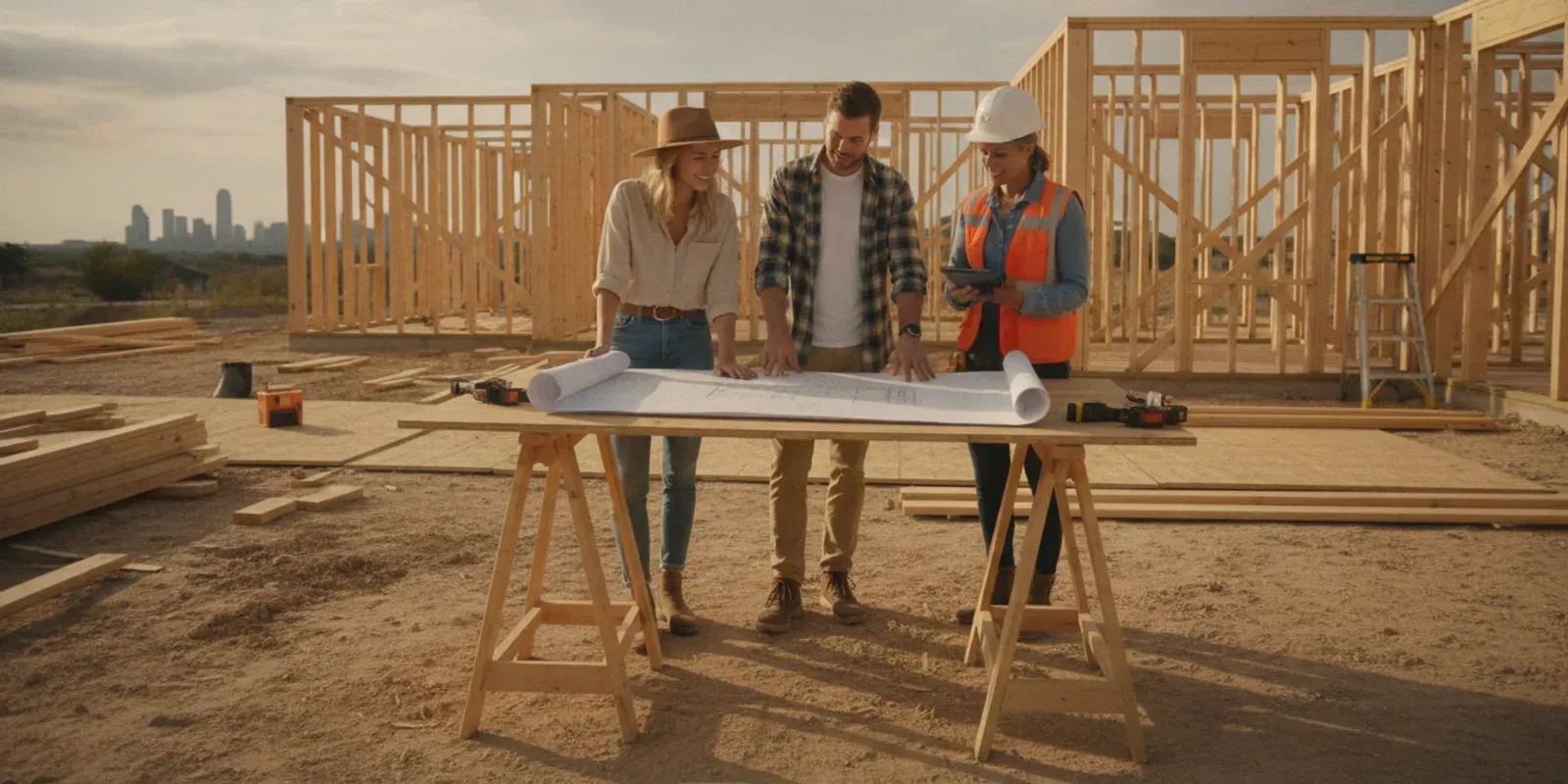

Insurance Custom Home During Construction Texas: Practical Planning Guide
Learn who may insure a custom home during construction, which policy details to verify, and how to coordinate coverage with your builder, lender, and agent.

Insurance custom home during construction Texas planning starts by identifying who covers the work in progress, materials, and liability at each stage. The answer depends on your construction contract, lender requirements, property, and actual policy terms. A builder’s policy does not automatically cover every risk, and a standard homeowners policy may not fit an unfinished house.
Discuss your custom-home plans
Before work begins, ask the builder and your insurance agent to put responsibilities in writing. Confirm which policies apply, who is insured, when coverage starts and ends, what the deductible is, and what proof the lender requires. ROSÖ Homes builds custom homes in the Dallas-Fort Worth area. Buyers can review its build-on-your-lot process while preparing project questions.
What insurance may apply during home construction?
There is no single policy label that settles every construction risk. Depending on the contract and financing arrangement, coverage may involve builder’s risk or course-of-construction insurance, the builder’s commercial general liability, workers’ compensation, and eventually a homeowners policy. The wording, limits, exclusions, insured parties, and effective dates matter more than the name alone.
Builder’s risk is commonly intended to address certain physical losses to a building while it is being constructed. Its scope varies by policy. It may cover the structure and specified materials, but limits, exclusions, conditions, and deductibles can apply. Ask whether it includes materials stored off-site or in transit, temporary structures, theft, water damage, or weather-related losses. Never rely on a verbal statement that “the project is covered.” Request the relevant certificate and ask your agent whether policy or endorsement details should be reviewed.
The builder’s liability policy is different. It generally addresses certain third-party claims alleging bodily injury or property damage connected to business operations, subject to policy terms. It is not a substitute for property coverage on the home itself. Workers’ compensation is also distinct and concerns employee work injuries under applicable requirements and policy terms. Request current documentation and ask how coverage applies to subcontractors. Do not assume every trade has identical insurance.
A lender may impose insurance conditions in its loan documents. The lender, not the builder, sets its own loan requirements. Ask the loan officer which coverage, limits, endorsements, named parties, and evidence are required, and when the documents are due. For broader context on roles and project planning, see ROSÖ Homes’ guide to construction financing and builder contracts.
Who should arrange the coverage?
Responsibility can vary by contract and financing. Some builders arrange a course-of-construction policy; in other cases, the property owner or lender may be expected to arrange or verify it. Do not infer responsibility from a custom or from a casual conversation. Find the relevant provision in the signed agreement and ask for clarification before groundbreaking if it is unclear.
Ask the builder direct questions, and keep the answers with the contract:
- Who obtains the policy covering physical damage to the work in progress?
- Who is the named insured? Should the owner or lender be listed as an additional insured, loss payee, or mortgagee?
- What are the policy’s effective and termination dates?
- Which property, materials, site features, or temporary works are included or excluded?
- What deductible applies, and who is responsible for it if a covered loss occurs?
- Can you provide a current certificate and respond to follow-up questions from my agent?
Then ask your own insurance agent to assess your position as the landowner and future occupant. A certificate can be evidence that a policy exists, but it is not a full description of coverage and does not change the policy. For an important coverage decision, ask the agent to review the actual policy and endorsements rather than relying only on the certificate.
How do construction and homeowners coverage differ?
A completed residence and a home under construction present different exposures. A standard homeowners policy may not be designed for a substantial construction project in progress. A construction policy may not provide the same personal-property or liability protection as a homeowners policy. Ask your insurer when to transition coverage and what to do if you already own the lot or live nearby during construction.
Plan the transition as a specific handoff, not an assumption that one policy simply replaces another on the day the keys arrive. The insurer may need to know when the home is complete, when it will be occupied, and whether any work remains. Ask who will confirm the effective date of the completed-home coverage and whether the construction policy needs an extension if the schedule changes.
This table is a conversation aid, not a coverage recommendation. A licensed insurance professional should determine what fits the specific property and contract. The Texas Department of Insurance provides consumer information; see its official website and confirm project-specific terms with your insurer.
What details should you check in a builder’s risk policy?
Coverage can differ substantially between policies, so review the declarations, schedule, and endorsements with an agent. Work through the following items in order. This makes it easier to spot unanswered questions before materials arrive or work starts. Bring the construction description, address, estimated value, contract, and anticipated schedule to the conversation. A clear question supported by project facts is easier to answer than a broad request to confirm that everything is covered.
- Insured value: Ask how the limit is set and whether it reflects expected completed value or another stated basis. Find out how approved changes or additions are handled. If the project scope changes, ask whether the insured value must be updated before the work is done. A large design revision, upgraded finish package, or addition can make the original figure worth checking again.
- Covered property: Check whether coverage applies to the structure, materials at the site, materials in storage elsewhere, and materials in transit. These may be treated differently. If specialty items are delivered early, identify where they will be stored and whether that location is addressed. Get the storage address and expected dates in front of the agent.
- Perils and exclusions: Ask specifically about wind, hail, fire, theft, vandalism, water intrusion, flood, earth movement, and any protective safeguards. Do not assume a peril is covered because it is common in Texas. Request an explanation of exclusions that could apply to your site.
- Deductibles: Determine whether separate deductibles apply to certain causes of loss and who bears the cost under the contract. Ask how a deductible would be handled if a loss affects both the work and materials. A dollar figure alone is not enough; understand the event that triggers it and who must pay.
- Vacancy and security: Ask whether the insurer requires fencing, locked storage, inspections, alarms, or other site safeguards. Identify who is responsible for doing and documenting that work. If several parties share site duties, write down who checks that each condition is met.
- Changes in scope: Find out when the insurer must be notified if plans, value, schedule, or construction methods change. Clarify whether an email acknowledgement or a formal endorsement is needed.
- Loss handling: Confirm who reports a claim, who communicates with the carrier, and how proceeds are handled if the lender has an interest in the property. Ask how to document damage and preserve records.
Use written answers. If a response is unclear, send the question to the insurance agent or carrier that can interpret the actual policy. Neither a builder’s estimate nor a certificate should be treated as a promise that a particular loss will be paid. Keep a copy of the answer beside the document it explains, so a later project handoff does not depend on someone remembering a phone call.
How should you coordinate with your lender and insurer?
Start early enough to avoid uncertainty before work begins. The lender may require evidence before a closing or draw. The insurer may need details about construction, occupancy, value, and site protections. The builder can provide project information, but the lender sets financing conditions and the insurer determines coverage under its policy. Keep these roles separate: a builder can explain the work and contract, but cannot decide what a lender will accept or how a carrier interprets policy language.
- Read the contract. Locate insurance, risk-of-loss, indemnity, and responsibility clauses. Note any deadlines for certificates or policy evidence. If the contract says one party will maintain coverage, ask what documentation confirms that obligation.
- Ask the lender for its checklist. Request exact requirements in writing, including parties to be named, limits, endorsements, and delivery dates. Ask whether the lender has a required form or wording for evidence.
- Contact your insurance agent. Explain that the property is a custom home under construction in Texas. Share the contract and lender requirements so the agent can identify questions or mismatches. Ask what information is needed to evaluate the project.
- Obtain builder documentation. Request current certificates and ask who will provide updates if coverage changes, expires, or is renewed. Record the contact responsible for sending updated documents.
- Compare names and dates. Check that the property address, insured parties, lender details, and coverage period align with the project and loan instructions. Resolve discrepancies rather than assuming they are harmless.
- Confirm the effective dates. Make sure relevant coverage is active before the exposure begins, with no gap between policies or at completion. Ask what happens if the schedule moves.
- Keep a project file. Store the signed contract, certificates, policy documents, lender instructions, correspondence, and renewal confirmations together. Keep a note of who answered each question and when.
If you own the land already, ask whether your current property or liability policy changes once construction starts. Do not cancel or alter existing coverage based on assumptions. The insurer should explain how construction affects the policy and what replacement or additional coverage may be appropriate. Include the lot address and expected work start date when you make that inquiry.
How can you check coverage at each project stage?
Insurance questions are easier to manage when tied to actual milestones. Make a small date list and revisit it whenever the project schedule changes. The list does not determine coverage; it helps you ask the right party before an exposure shifts. Put an owner next to each task. For example, the builder may provide updated project value, the buyer may forward lender requirements, and the agent may confirm policy dates. Agree on a reasonable deadline for each answer rather than leaving a question open until the last moment.
- Before signing or finalizing the contract: Identify which party the agreement assigns responsibility for construction coverage and risk of loss. Ask the builder to explain unclear clauses. Share the draft with your agent if the insurance provisions affect what you must arrange.
- Before closing or groundbreaking: Obtain the lender’s requirements, confirm who will arrange each relevant policy, and verify the effective dates. Ask whether proof must be delivered before a particular event, such as a closing or first draw.
- Before materials are delivered: Ask whether stored or in-transit materials are within the policy scope. Confirm any security or storage conditions. If the material is kept away from the site, give the agent the location and ask whether that changes the answer.
- When plans, values, or timing change: Notify the responsible parties and ask whether a policy update or extension is needed. Do not assume an existing limit or end date automatically adjusts to the revised project.
- Before occupancy: Confirm when the homeowners policy should take effect and whether remaining punch-list work affects the transition. Ask how the construction policy ends and whether any extension is required.
For example, suppose a scheduled delivery moves ahead of site installation. That creates a practical question about where the materials are protected while they wait. The buyer should identify the location, ask the builder who is responsible for security, and have the agent check whether the policy addresses that storage arrangement. The answer should come from the actual policy, not from a general description of builder’s risk.
Consider another scenario: completion is delayed past the date written on the construction policy. Do not assume that coverage continues automatically because work remains. Contact the party responsible for the policy and ask the insurer about an extension before the stated end date. Then share any revised evidence with the lender if the loan requires it. Record the new end date and the person who confirmed it. If the completed-home policy is already scheduled, tell that insurer about the delay too; the expected occupancy date may affect its underwriting or effective date.
A third example involves a change in ownership or financing. If the lot is refinanced, ownership is transferred, or a lender’s name changes, the documents may no longer match the original project file. Ask the lender and insurance agent what must be updated. Do not edit a certificate yourself or assume that changing a mailing address updates the policy’s insured parties. Confirm any formal change with the issuer and retain the replacement document.
What should you ask before groundbreaking?
A short written checklist helps the buyer, builder, lender, and insurance agent work from the same facts. Resolve these points before construction begins:
- Which party is responsible for arranging property coverage during construction?
- What are the exact start and end dates of that coverage?
- Does the policy address the site, building materials, and work in progress, and under what conditions?
- Are the homeowner and lender correctly identified where required?
- What are the limits, deductibles, exclusions, and reporting obligations?
- What evidence does the lender need, and who sends it?
- How will a change in project scope, value, or schedule be reported?
- When should the completed-home policy begin, and who confirms the transition?
- What happens if the project is delayed or the home is not ready for occupancy when expected?
- Who should be contacted first if there is property damage, an injury, or a question about a certificate?
It can help to make the checklist a simple responsibility matrix. One column names the question, a second names the person responsible for obtaining the answer, and a third records the document or confirmation received. For example, “lender’s required certificate wording” might be assigned to the buyer to request from the loan officer, then to the builder or agent to supply. A separate line for “materials stored off-site” can record the storage location, the policy provision reviewed, and the agent’s response. This avoids treating a general certificate as proof of every detail.
Discuss schedule changes promptly. Do not make assumptions based on a general build-time statement; confirm the actual project schedule and policy dates with the parties responsible. ROSÖ Homes describes its approach on its custom home building page. That information does not replace written insurance terms or a lender’s requirements.
What should you do if coverage is unclear?
Pause and ask for clarification before relying on a policy or proceeding into a period with uncertain coverage. Put the question in writing and direct it to the party able to answer: the insurer or agent for policy interpretation, the lender for financing conditions, and the builder for contract responsibilities and project details. If the contract language itself is disputed, consider advice from a Texas attorney familiar with construction contracts.
Make the question precise. Instead of asking whether “everything is covered,” describe the property, event, and timing. For instance: “Are materials stored at this named location covered before installation, and does the policy require any specific security measures?” Ask for the answer in a form that can be kept with the policy documents. If the response points to an exclusion or endorsement, ask the agent to explain how it applies to your situation.
Keep updated certificates and endorsements. A renewal, extension, change in named parties, or schedule shift may require new documentation. Recheck dates when construction timing changes, when major materials arrive, and before occupancy. Do not treat an oral assurance as a replacement for documents the lender or insurer requires.
Frequently asked questions
Does the builder’s policy automatically cover the homeowner?
No universal answer applies. Ask who the policy names, whether the owner has any required status under it, what property is covered, and whether the actual policy terms support the protection you need. A certificate alone may not answer these questions.
Can I rely on my current homeowners policy?
Do not assume that a policy for an occupied, completed residence applies unchanged during substantial construction. Tell your insurer the property’s status and ask how construction affects existing coverage, including any liability or land-related protection.
Is builder’s risk the same as liability insurance?
No. Builder’s risk generally concerns specified physical loss to property under construction, subject to policy terms. Liability insurance addresses certain third-party claims. Each serves a different purpose, and one should not be treated as a replacement for the other.
What if the project schedule changes?
Contact the party arranging coverage, your agent, and the lender as appropriate. Ask whether dates, limits, or documents need revision, and obtain confirmation before relying on an extension or transition. Keep the updated evidence with the project file.
Contact ROSÖ Homes about your project
Insurance decisions depend on the contract, site, financing, and policy wording. Confirm coverage directly with your licensed insurance professional and lender, and put responsibilities in writing before construction starts.
| Coverage to ask about | Question it may address | What to verify |
|---|---|---|
| Builder’s risk or course-of-construction | What physical loss to the work in progress may be covered? | Covered property, exclusions, limits, deductible, insured parties, dates |
| Builder’s commercial general liability | What third-party injury or property-damage claims may be addressed? | Current policy period, limits, operations, and certificate details |
| Workers’ compensation | How may employee work injuries be handled? | Whether the builder and applicable trades maintain coverage as required |
| Homeowners policy | When may coverage for the completed residence and household begin? | Effective date, construction restrictions, occupancy status, transition steps |
| Umbrella or other personal coverage | Are additional owner liability limits appropriate? | Eligibility, underlying policy requirements, agent’s recommendation |